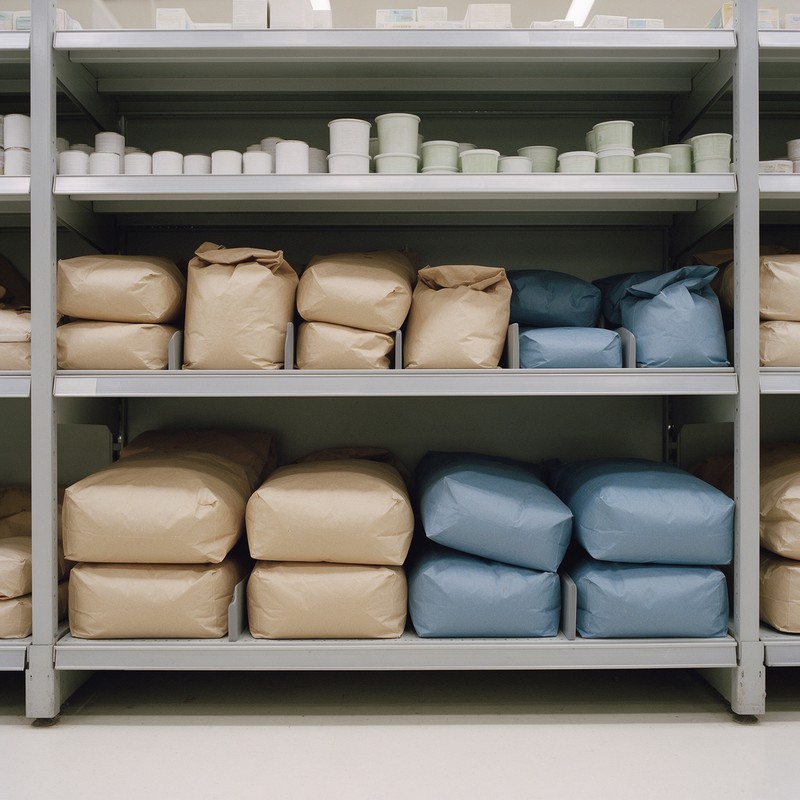
A fifteen kilo sack of dog food is the heaviest item in the aisle, and it is often stocked on the thinnest deck. Put three of those sacks on a light shelf and the beam bows, the edge strip lifts, and the sacks slump into the gap. The fix is not a stronger shelf everywhere. It is a bay that knows which deck carries the weight.
Set the two lowest decks at 300 and 450 mm and give them a 0.7 mm beam and a thicker edge rail; keep every higher deck on 0.5 mm, where cans, tubs and small cartons sit. Hold deck depth to about 400 mm so sacks stand two deep instead of four, and space the uprights at no more than 1.2 m on bulk bays. A shopper should see the sack face, not a wall of paper, and the deck should stay flat after a full drop of stock.
Sacks do not slide like boxes. They lean, settle and flatten at the base, which is why a run of bulk bags turns ragged within a day of restocking. Set a divider every 350 mm, sized to the sack footprint rather than the shelf width, and add a low front stop that holds the bottom edge without hiding the label. The run then reads as even columns from the aisle, and a missing sack is visible from ten metres away.
Restocking follows the same logic. New sacks come in from the end of the bay on a sack truck, drop onto the low deck, and get pushed forward from behind. Nothing is lifted over a second row and nothing heavy is carried to shoulder height. Fewer strained backs, fewer split bags on the floor, and less stock written off at the end of the week.
Swfixture builds heavy duty gondola bays, bulk decks and aisle dividers for supermarkets, pet stores and warehouse formats, sized to the sacks and cases you actually move. See the range at https://swfixture.com.

We are the most influential shop fitting company. And we will continue to work hard so that we can exceed your expectations! We hope to serve you soon with our products.

No 1, Yuhua Road, Shanghu town, Changshu City, Jiangsu Province, China 215551

+86 (0) 18015603878

Jack@swfixture.com


